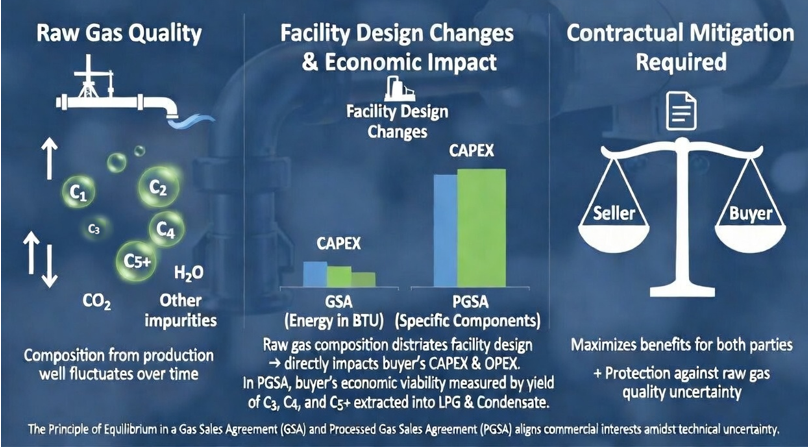

The Principle of Equilibrium in a Gas Sales Agreement (GSA) serves as a crucial legal instrument to align the commercial interests of the seller and the buyer amidst high risks of technical uncertainty.
For instance, in a GSA, experience demonstrates that the raw gas composition C1, C2, C3, C4, C5+, CO2, H2O, and other impurities from a production well will fluctuate over time. Although the primary object of trade is energy (measured in BTU), the raw gas composition dictates the facility design, which directly impacts the project economics (CAPEX and OPEX) for the gas buyer as the party utilizing the raw gas.
This matter is particularly more sensitive in a Processed Gas Sales Agreement (PGSA), where the trade focuses on specific gas components (e.g., C3, C4, and C5+). In such cases, the buyer’s economic viability is measured by the yield of C3, C4, and C5+ extractable from the raw gas to produce LPG and Condensate.
Consequently, a
balance between the seller and the buyer is essential when assessing the
quality of the traded raw gas. Contractual mitigation is required under
the agreement to ensure that each party maximizes its respective benefits
while securing protection against the inherent uncertainties of
raw gas quality.